maanantai 28. tammikuuta 2013

What is a tomesode-houmongi?

Remember the mystery kurotomesode I bought for cheap? This one:
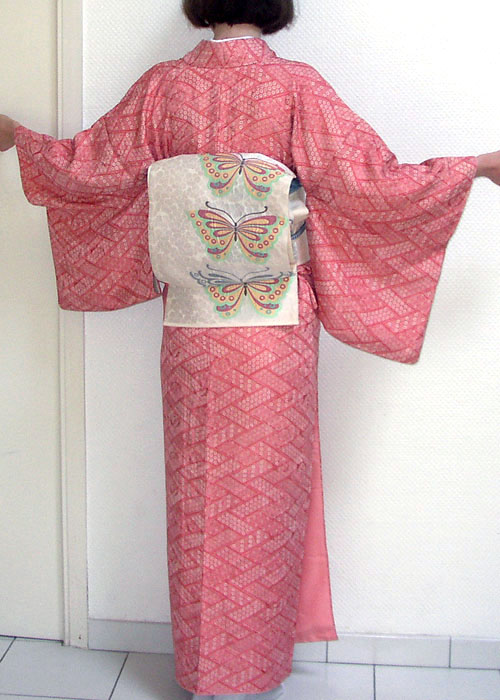
It had pine patterning also on the left breast as well as the hem of the kimono. After asking (and forgetting the whole damn thread) in IG, I got some idea what this might be and what formality it is.

Image provided by Muhvi.
In formality such a kimono sits right behind tomesode, before houmongi, as it's a hybrid of these two. Kokoro from IG found out that: "Lately at theaters and parties where the guests will sit in chairs both black and colored tomesode are worn with designs at the shoulders and sleeves as well as at the skirt."

Kimono owned by Moonblossom.
 As when you are sitting down at a table, a theatre box etc. the hem patterning does not show, but giving the hints on shoulders and sleeves that there is a pattern on the kimono makes it festive rather than mistaking is for mourning wear (if obi is not visible).

Image provided by Muhvi.

The quote Kokoro provided is from 1979 so this kind of hybrid is rather new installation.

Image provided by Muhvi.

Also the kurotomesode is considered "mother-of-a-bride" so having splashes of pattern on the breast might be considered more youthful and less formal, while still being on the highest levels of formality. Moonblossom asked Yuka from Ichiroya about this kind of kimono and she said that this kind of kimono can be worn to very formal occasions by unmarried women.

These kimono are not always silk. Atleat the one I own feels like it's synthetic.

maanantai 14. tammikuuta 2013

Maybe finally I could start with 2013...

Well, my new year's resolutions were blown on the first weeks, HA! Must be a record even for me. But seriously, school/work has been hell lately and I've been busy as a beaver for the last two weeks. Last week we had the first of our two big tests and everybody was cranky/stressed and some didn't show up at school, which meant more work for those who did as we had to patch up. Long story short, I passed the test but I'm not waiting eagerly to the next one in the spring.

But something kimono related, I bought a charming little book called The History of Women's costume in Japan and it arrived last week to cheer me up. The book is in japanese.

The Cover
It's a pocketbook size book with 255 pages of goodyness. With Costume Museum's help I identified the first chapter to be (possibly) the Ancient Burial Mounds era or Ancient tomb culture.


It was interesting to flip through these first pages as the clothes resemble (atleast to me) very much of the Korean hanbok. The belt is also quite wide compaired to the later centuries until the obi starts it's rise in the Edo period. Also, everyone who has gotten any information about kimono, will know that the kimono collars go left-over-right, but in these early pictures right-over-left seems dominant. The next chapter shows that both styles were in use, but the left-over-right is starting to be dominant.


During this chapter the chinese influence is more visible than Korean, but this was the time that the japanese fancied the chinese court and modelled their own fashion according to the chinese. When the Heian period is rolled in, the left-over-right is the only dominant way to put the collars on a living thing.

The other interesting feature I didn't realize until I was near the end of the book. Soemwhere along the Edo period my eyes caught this very fanciful design on the kimono and it took me a while to realize that it was the family crest as the same pattern was repeated 5 times on the places where the mon's are located.


Pretty isn't it? There was a few other similar mon design. I flipped back and forth in the book trying to find mon's on the earlier periods to see what kind of design they had. But couldn't find any. I also noticed the more "normal" geometric mon designs during the Edo chapter, but these decorative mon's really sparked my interest.

I have to keep a lookout for a book on men's kimono history so I can compare and see when did the mon's appear on male garments.

As always, better scan's are in my flickr page. I did not scan the whole 255 pages of the book! Just a few selected bits and pieces!

To Flickr: The History of Women's Costume in Japan

maanantai 31. joulukuuta 2012

The New Year Promises for 2013

Wow, is it new year already? Holy macaroni! I didn't do half the stuff I promised to do for this blog T.T... But to my rescue, I had to read to tests each week and then there was the suffle with my old school. But I'm trying coach! xD

Well, here's my New Year Promise(s):

1. I solemly promise to do kitsuke once a week on Kitsuke Day (most likely Saturday/Sunday)
2. I solemly promise to do SOMETHING kimono/japan related each week besides kitsuke.

I'm very bad at keeping long term promises, but I hope I will keep these ones!

What's your New Year resolutions?

tiistai 6. marraskuuta 2012

20s shoes!

Ever wanted a pair of 20s shoes to match your nice taisho style? Well, the American Duchess has put the preorder up for the 23Skidoo Spectator shoes!  You can find them here: American Duchess Shop

23Skidoo
Aren't they purdy? Aaaaand getting along with my habits, here's a little product information:

  • Uppers are high grade, soft, hand-stitched calfskin (that will stretch slightly over time). 
  • Faux leather sole with excellent wear characteristics and suitable for dancing.
  • Custom made French heels are 2 3/8 inches high, and perfectly balanced for all-day comfort.
  • 23 Skidoo has been constructed on dance shoe lasts, and is meant to fit snuggly, as a dress shoe.
  • "B" width (average).
  • It runs true to size for most customers.
  • Order a half-size larger for wide-width feet, if you prefer your shoes to fit more loosely, or intend to wear with thicker stockings.
The shoes are also dyable so you can have them in any shade or color you want! How about that?

Enjoy!

sunnuntai 28. lokakuuta 2012

In Our Town of Halloween

Halloween is officially on Wednesday, but we are working/in school then and scathered around the country, so we celebrated Halloween yesterday. It was great fun to see friends, since two of them I can only see once in a year, during our halloween party^^. The party itself is non-alchoholic, only fizzy drinks and water allowed, but you can have fun even without alchohol. Most of the group is teadrinkers in any case.

But well, here are some pictures of the kitsuke I wore:
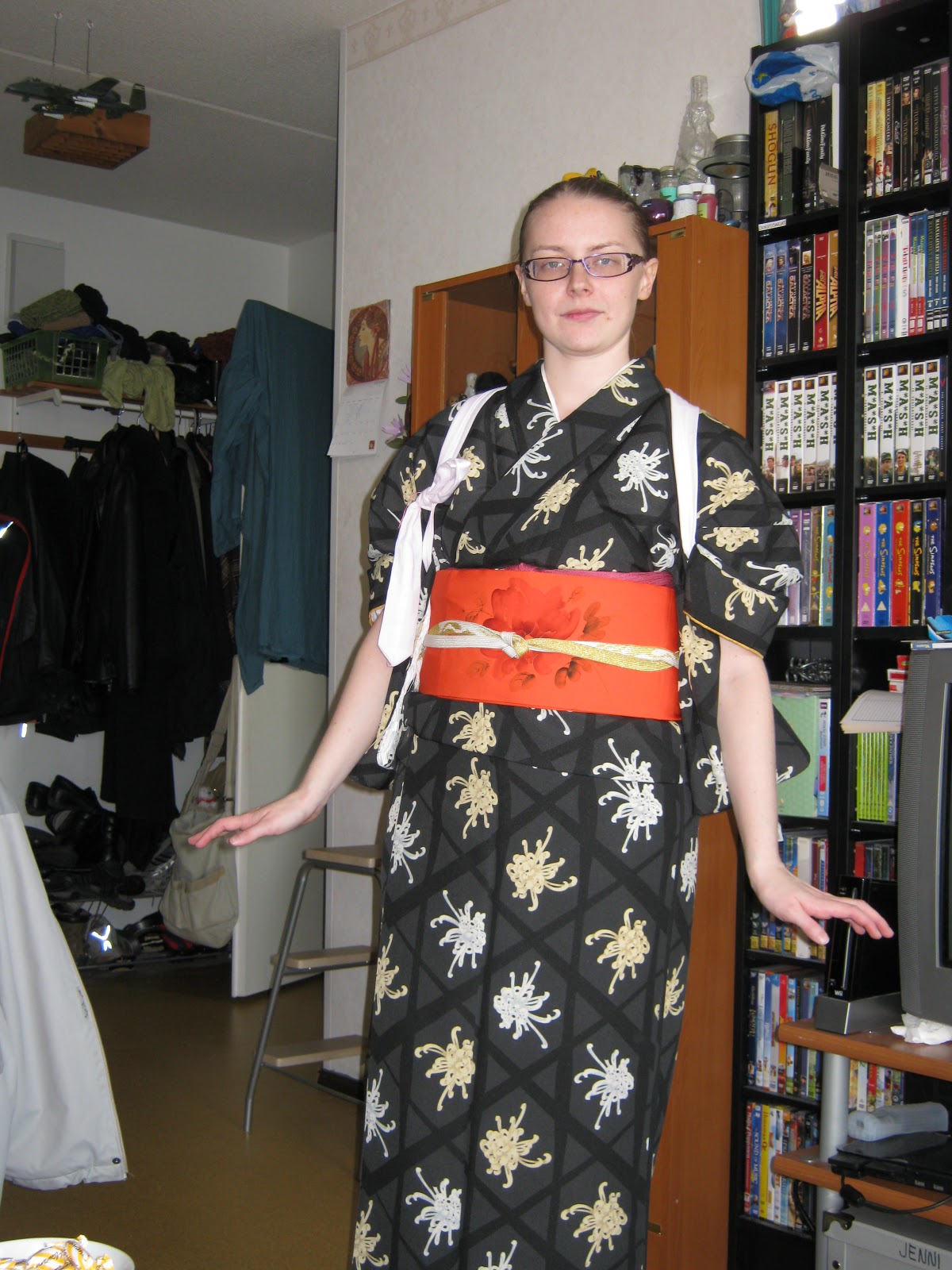
First I thought of using a mofuku, but I was not sure about the appropriesness (is that even a word? It is now!) and the fact that I had to be cleaning and cooking before the party starts, so I settled on to one of my newest ones, a jinken komon with chrysanthemum pattern. While dressing I noticed something rather awesome: This kimono is perfectly my size! Except maybe around the bust, but that's something I should have noticed while dressing. My collars kept sliding up all evening.

Because these images are pre-party, I'm having my sleeves pulled up. I let them loose when the guests started to arrive.


 I don't think I have never gotten a better profile. This must be because I went to have my spine snapped back into place on Friday. I had a wrong position of the hips, and in this picture my spine has been restored into place. It didn't hurt a bit, but I learned that I have loose joints in the hips, which had slipped into a bad position and caused my back to ache. But now they are back to normal and my back doesn't hurt.^^

 Our two gentleman guests carved this pumpkin for us. They are no experts, but I think they made a good job.
HAPPY HALLOWEEN EVERYBODY!

torstai 18. lokakuuta 2012

Kimono patterns: Dyed patterns

I've been putting this off for too long now, as I feel that my knowledge in this field is lacking, but I'm giving it a go in any case. Since I have now proclamed my lack of knowledge, please understand that mistakes are possible and if you know better than me, you are free to correct me. Thank you for understanding.

Dyed patterns on a kimono

Ai-zome is indigo dyeing. The basic material for this dye comes from the leaf of the polygonym tinctorium plant. The japanese method to extract the dye is different than that in the world. Kosoen.com has a good explanation on how the dye is processed and made. Indigo dyes are mostly used in yukata.
Image from here
Bingata originates in the Okinawa and the Ryukyu Kingdom (c. 14th century). The term "bingata" does not appear in the old documents and it was called  the katachichi (to apply patterns) or hana-nunu (flower cloth). The first person to call this fabric bingata was Iha Fuyu (1876-1947), which means that as a term, bingata is a rather new, but as a fabric dyeing technique, it is an old one.
Read more about bingata in jahitchcock.com

Image from here
 Edo komon became popular when Edo (modern day Tokyo) became the centre of komon production. Especially komon pattern made from small pinpoint dots. The pattern is made by forcing rice paste through a small stencil, making a pattern of small dots, and then dying the backgroung fabric. The rice paste keeps the pattern white while the rest of the fabric takes the dye. In early Edo period the colors for Edo komon were mainly indigo-white. About Edo Komon has a detailed information on the process on making an Edo komon kimono.
Image by kimono.fraise.net
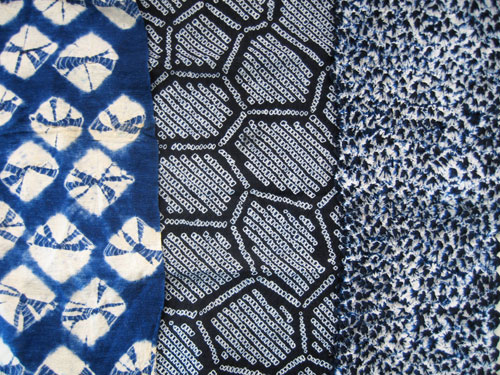
Shibori is the general term for several types of tie-dye dyeing. The fabric can be binded, stitched, folded, twisted, compressed or capped. Even I know that wikipedia is a bad place to use as information goes, but the shibori section does list a few shibori technique names and explanations. How reliable these are, I cannot say for sure, so read with causion.
Image from here
Yuzen is a starch-resist dyeing technique invented by Miyazaki Yuzen during the Genrokuera (1688-1704) of Edo period. The technique uses glutinous rice as the resist, which allows the freestyle design. Yuzen has watercolor like patterns and harmoniously blending colors. The realistic touches on the pattern finishes the look. Short History of Yuzen Dyeing foundable here.
Image from Here
Image from here
Hachijou is listed in the Book Of Kimono by Norio Yamaka as a yellow cloth first made in the Hachijou island near Tokyo. There are three kind of hachijou colors: bright yellow Kihachijou color is produced from a dye extracted from the kariyasu grass, the brown Tobihachijou comes from the madami plant and the black Kurohachijou dye comes from the bark of the chinquapin. Characteristic design for these kimono are stripes or checks, in either plain weave or twill.
Kihachijou kimono from here
Image from here
Keiichi Takasawa lists these next terms in his book Kimono: A pictorial story of the kimono (1948):

Conserning general dyeing process:

Shinzen vat-dyeing in single color
Nassen print dyeing, using copper roller
Nukizome dyeing with colored paste
Hikizome dyeing with brush and stencilled papers
Surizome dyeing by rubbing over stencils
Sosogikomizome dyeing as in the popular tenugui towel
Kakizome designs hand painted with dyes by artists
Kukurizome tying with threads and dyeing
Kouketsuzome Another name for kukurizome
Suminagashi dyeing in the "grain of wood" pattern
Rouketsuzome dyeing with wax, like Javanese batik
Kirifukizome dyeing with sprayer
Tsutsuhiki dyeing with a paste tube
Kureonzome dyeing with crayons.

Conserning kimono patterning:

Soumoyo all over pattern
Susomoyo hem pattern
Uramoyo lining pattern
Semoyo back pattern
Yagasuri scattered arrow-shaped figures
Sharyou fretwork
Ichimatsu chequered
Sambenkoshi three bar fretwork
Dandara checkers
Asanoha hemp leaf

The kukurizome and the kouketsuzome seem to be some kind of shibori techniques. I had never heard some of these terms before I got these books and I do not know if they are still in use. I listed them here incase someone has come against there terms and wasn't sure what they meant. The book was published 1948 so some of these terms might not be in use anymore. I'm still doing research on these, so I'm sorry I cannot provide more information on these. They are fascinating thou.

It's time for a kitsuke

Kiki enjoying a pile of silk kimono items.

Well, atleast more or less. Two of my latest kimono have not yet arrived and I've been trying to clean this appartment (with no much success). First one is a handmade kimono. The fabric I bought from the local Eurokangas fabric store. As you can see from the pattern, it's a komon, but I was short on everyday kimono, so it's perfect.


Next one is the purple-white tsumugi.

 Aaaaand then I just had fun.
 Then I remembered that I had a mofuku I had not found any use yet: